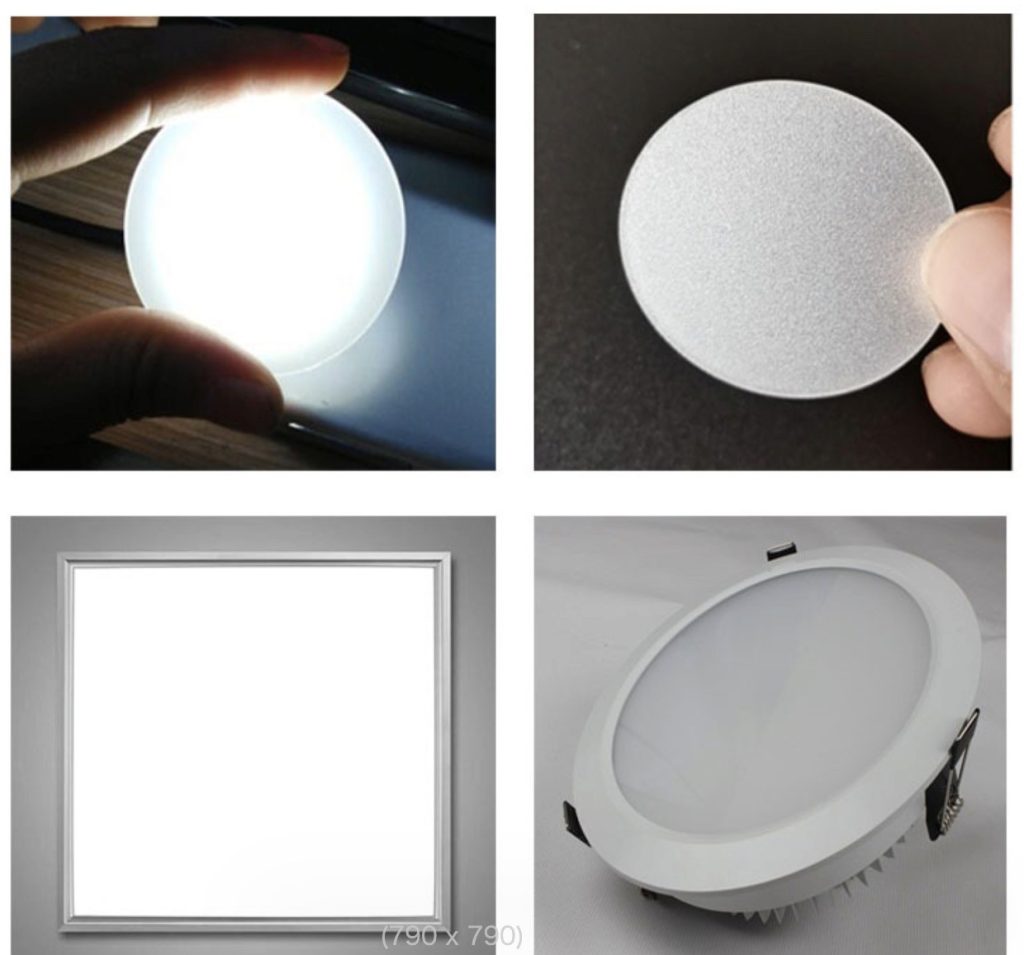
Light transmission indicates how much incident light passes through LED diffuser sheets, while haze indicates what share of the transmitted light is scattered away from the direct beam. Transmission relates to potential output; haze relates to light distribution. Neither value alone proves that finished luminaires will be bright, uniform or free from visible LED hotspots.
Compare both values under the same test conditions, then validate sheets in intended fixtures. LED pitch, diffuser distance, beam angle, thickness and diffusion technology can matter as much as data-sheet percentages.
What Does Light Transmission Mean in LED Diffuser Sheets?
Light transmission, often specified as luminous transmittance, is the proportion of incident light passing through materials under defined conditions. Higher transmission provides more available light and may help manufacturers reach target fixture output efficiently.
However, sheet transmission is not the same as finished-luminaire output or efficacy. Transmitted light may be redirected, absorbed after internal reflections or sent outside the useful beam. Housing geometry and other optical components determine how much becomes useful illumination.
Data-sheet comparisons require consistent conditions. Results from different thicknesses or surfaces are not directly equivalent. Confirm the method, specimen thickness and measurement type. ASTM D1003 is commonly used for transparent plastics, but its values describe tested specimens—not every fabricated part.
What Does Haze Measure?
Haze is the percentage of transmitted light that is deflected from the direct beam by wide-angle scattering. Under ASTM D1003, this generally means light deviating by more than 2.5 degrees. Clear sheets usually have low haze because most light continues close to its original path. Diffusing sheets use bulk-scattering particles, engineered surfaces or combinations of both to redistribute light and produce higher haze.
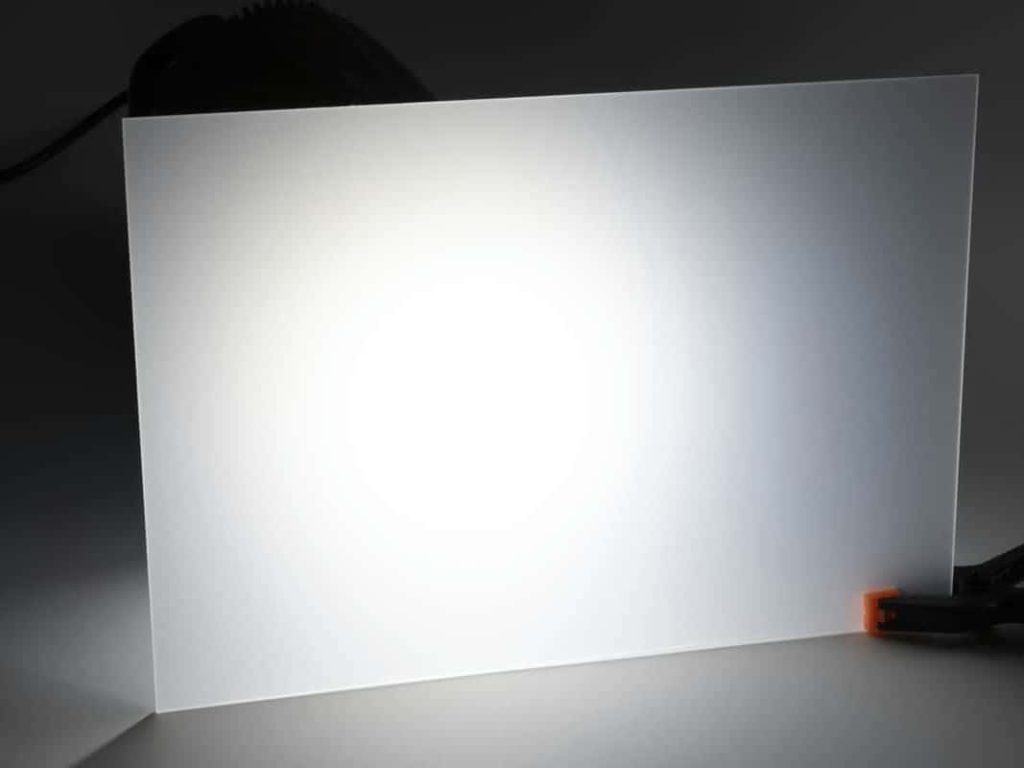
Haze does not mean opacity. LED diffuser sheets can show high transmission and high haze simultaneously: much of the light passes through but exits in scattered directions. Luminaires often need both useful output and visual mixing.
Haze must be separated from clarity, diffusion angle, glare and LED hiding power. It records how much transmitted light enters the wide-angle category, but not where that light goes within the category. It therefore cannot show whether patterns from a particular LED board will overlap evenly. High haze can support hotspot reduction without guaranteeing it.
Why Transmission and Haze Must Be Evaluated Together
The correct target is not the highest transmission or haze. It is the highest usable fixture output that still satisfies requirements for LED hiding, luminance uniformity, glare and appearance.
| Optical profile | Likely advantage | Main risk | Typical evaluation context |
|---|---|---|---|
| Higher transmission, lower haze | Preserves more potential output | Visible LED points or uneven brightness | Deeper fixtures, dense LED arrays or designs with secondary optics |
| Balanced transmission and haze | Combines output with moderate source hiding | May fail in very shallow assemblies | LED panels, lightboxes and general luminaires |
| Stronger scattering with lower transmission | Can provide stronger visual masking | Reduced output and duller appearance | Shallow fixtures or widely spaced LEDs, subject to testing |
These are design directions, not fixed product classes. Engineered diffusers may provide better source hiding at a given transmission level than conventional opal sheets, but “high diffusion” labels cannot prove this. Comparable data and samples are necessary.
Replacing approved sheets with alternatives that match only transmission may preserve output but expose LED dots. Matching only haze creates the opposite risk: sheets may scatter strongly while sacrificing too much useful light.
Why Similar Specifications Can Produce Different Results
Two LED diffuser sheets with similar transmission and haze can look different because these numbers compress complex angular behavior into two measurements.
LED pitch and optical distance are especially important. When LEDs are widely spaced or diffuser sheets sit close to the board, adjacent light patterns may not overlap sufficiently. Stronger scattering can help, but no universal haze level or spacing ratio ensures uniformity because beam angles, package optics and cavity reflectance vary.
Bulk-diffusing additives scatter light throughout materials, while textured surfaces redirect it at interfaces. These technologies can produce different angular distributions despite similar haze. Greater thickness changes optical path length, scattering and absorption, but does not automatically provide better LED hiding.
Fabrication introduces further variation. Thermoforming can reduce local thickness, while printing, coatings, polishing and surface orientation may alter optical behavior. Whenever possible, test samples after the planned process.
Tunable-white and RGB systems may also reveal color-mixing or spectral differences hidden by a single transmission value. Include viewing angle, operating current and off-state whiteness when relevant.
How to Specify and Test LED Diffuser Sheets
Useful requests for quotation should connect LED diffuser sheet specifications to actual lighting systems. Buyers should provide:
- Sheet material, thickness and requirements for impact, heat, UV exposure or flame performance
- LED type, pitch, beam angle, board layout and operating conditions
- LED-to-diffuser distance, cavity dimensions and reflector arrangement
- Target transmission and haze with the required test method and specimen thickness
- Acceptance criteria for fixture output, uniformity, hotspot visibility, glare and color shift
- Final geometry and planned forming, printing, coating or machining
Test candidate sheets in production-representative fixtures. Loose samples cannot reproduce source spacing, optical distance or cavity reflections. Measure fixture output and luminance uniformity, then inspect LED patterns from defined distances and angles. Check chromaticity or correlated color temperature when color consistency is important.
If numbers cannot describe appearance adequately, use an approved illuminated assembly as a visual reference. Procurement documents should still record the grade, thickness, surface orientation and agreed tolerances. This prevents nominally similar replacements from changing fixture appearance.
Selection Priorities for Different Applications
Shallow LED panels and slim lightboxes should prioritize proven hotspot hiding at the available distance. Maximum transmission may create bright but visibly spotted surfaces. High-output luminaires need strong transmission without unacceptable source imaging or glare.
Backlit signs require uniformity without weakening printed colors. Decorative covers add off-state color, gloss and texture. For impact-prone, outdoor or heat-exposed fixtures, first qualify acrylic or polycarbonate sheet families for environmental and mechanical needs, then compare their diffusion grades.
Frequently Asked Questions
Is higher haze always better for LED diffuser sheets?
No. Higher haze indicates stronger wide-angle scattering under the stated test method, but it may coincide with lower usable output and does not independently guarantee hotspot-free fixtures.
Can diffuser sheets have high transmission and high haze?
Yes. Transmission measures how much light passes through, whereas haze measures how much transmitted light is scattered. Properly designed sheets can perform strongly in both measurements.
What haze level is best for hiding LED hotspots?
There is no universal level. Required performance depends on LED pitch, beam angle, optical distance, sheet thickness, cavity design and scattering distribution. Prototype testing is necessary.
Should acrylic or polycarbonate diffuser sheets be selected by optical data alone?
No. Impact resistance, service temperature, UV exposure, flame requirements, fabrication method and dimensional needs should qualify the base material before optical grades are compared.
Conclusion
Light transmission measures throughput potential, while haze describes wide-angle scattering. The figures are related but not interchangeable, and neither proves finished-fixture performance. Reliable selection combines comparable material data with tests using the actual LED layout and optical distance. Defined output, uniformity, hotspot and appearance requirements help manufacturers balance efficiency with visual quality instead of choosing the highest percentage.