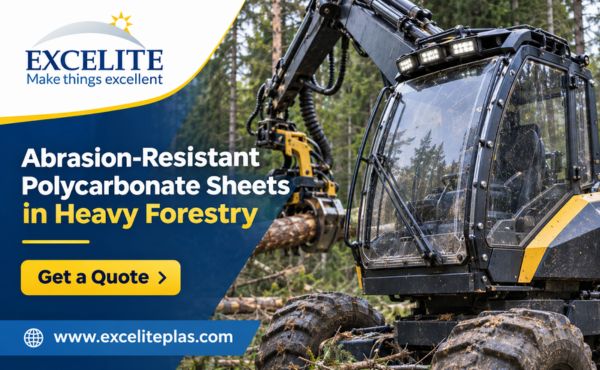
Operating heavy forestry equipment is one of the most hazardous industrial environments on Earth. In clear-fell logging sites across New Zealand, the Pacific Northwest, Canada, and Scandinavia, harvesters, feller bunchers, and processors push mechanical stress to its limits. Among the most severe operational risks operators face are falling timber, violent log kickbacks, and high-velocity chain shot—a catastrophic failure where broken saw chain teeth turn into ballistic shrapnel traveling at speeds exceeding 300 meters per second.
Standard automotive glass cannot withstand these impact energies, while conventional uncoated plastics scratch to near-opacity within days under abrasive timber sludge and wiper friction. To guarantee structural survival and crystal-clear visibility, equipment upfitters and regional safety fabricators rely on abrasion-resistant polycarbonate sheet technology.
Here is a breakdown of how hard-coated polycarbonate functions, how to select thickness and verify impact ratings, and how precision pre-fabrication supports the global replacement forestry windows market.
Hard-Coated Polycarbonate Sheets for Forestry Applications
A standard clear thermoplastic sheet will shatter under ballistic impact or haze within hours of operation. High-performance forestry cab safety window applications demand a material engineered for simultaneous core ductility and surface hardness.
Dual-Sided Siloxane Hard Coating
Uncoated polycarbonate has a soft surface prone to micro-marring. Premium hard-coated polycarbonate undergoes a specialized liquid flow-coating or dip-coating process that applies an optical-grade organosilicon (siloxane) layer to both sides.
- Taber Abrasion Resistance (ASTM D1044):Quality materials must register a $\Delta\text{Haze}$ of less than 2% to 4% after 100 cycles using CS-10F wheels under a 500-gram load. This ensures windshield wipers operating over gritty volcanic ash or pine dust will not ruin optical clarity.
- Chemical & Environmental Stability:The hard layer prevents clouding from hydraulic fluids, grease, diesel exhaust, and intensive tree-sap solvents while blocking 99% of damaging UV radiation.
Core Toughness vs. Optical Precision
The inner polymer matrix maintains an impact resistance roughly 250 times greater than standard float glass and 30 times greater than acrylic. For heavy machinery, thickness alone is insufficient; internal stress must be strictly managed during extrusion to maintain visual light transmission (VLT) above 75% without spatial or prismatic distortion that causes operator fatigue.
Abrasion-Resistant PC Sheet Thickness and Safety Standards
Windshield placement determines the required physical thickness and testing certification. A skylight exposed to falling twigs requires a completely different specification than a primary windshield directly in the line of high-speed saw bar fire.
| Cab Position | Recommended Thickness | Primary Risk Mitigated | Relevant Testing Standards | Material Construction |
| Front Working Windshield | 19 mm (3/4″) to 32 mm (1-1/4″) | Chain shot protection, log kickbacks, bar derailment | ISO 21876, WorkSafeBC, WorkSafe NZ ACoP | Monolithic dual-side hard-coated PC or glass-clad PC composite |
| Side Doors & Boom Inspection Windows | 9.5 mm (3/8″) to 12.7 mm (1/2″) | Roll-over impact, side branch strikes, falling debris | ISO 8084 (OPS), ISO 10262 Level II (FOPS) | Hard-coated optical PC with pre-chamfered edges |
| Rear Windows & Escape Skylights | 6.0 mm (1/4″) to 9.5 mm (3/8″) | Light branch scrapings, ballast spray, emergency egress | Basic FOPS / Falling Object criteria | Lightly coated or standard abrasion-resistant PC |
Navigating Ballistic Testing Regimes
- ISO 21876 (Saw-chain shot testing):The definitive international standard for harvester cab glazing. It subjects test coupons to ballistic saw chain fragments shot at specific velocities and angles to confirm the fragment is captured without internal cab spalling.
- ISO 10262 Level II (FOPS):Verifies the cab glazing and roof system can absorb the drop energy of a 227 kg blunt object falling from a height of over 5 meters.
- Regional Directives:Operations in Australasia must strictly comply with the WorkSafe New Zealand Approved Code of Practice (ACoP) for safety revamps, while North American logging contractors are audited against strict OSHA and WorkSafeBC
CNC Machining of Abrasion-Resistant Polycarbonate Sheets
Processing thick abrasion-resistant polycarbonate sheet stock requires rigorous mechanical discipline. Improper cutting ruins the hard coating and introduces micro-fissures that cause catastrophic failure under shock loads.
- Cold Cutting vs. Thermal Stress
Laser cutting should never be used on heavy-gauge polycarbonate. Laser heat vaporizes the polymer, carbonizes the siloxane coating, and induces severe internal tensile stresses that crack under minimal deflection.
- All profile cuts must be executed using high-pressure abrasive waterjet cuttingor multi-axis CNC routers equipped with polished, single-flute or twin-flute diamond/carbide spiral down-cut bits running at optimized chip loads to avoid heat buildup.
- Edge Dressing and Stress Relief
When a sheet is cut, the outer edge contains micro-scratches that act as primary fracture propagation points.
- Finished panels must undergo mechanical edge dressing, applying an edge radius of R1.5mm to R3.0mm (or a precision 45-degree chamfer).
- Removing sharp right-angle edges distributes kinetic energy evenly through the panel during a ballistic impact.
- Thermal Expansion & Anti-Crush Bushings
Polycarbonate exhibits a thermal expansion coefficient roughly 5 to 8 times higher than structural steel.
- Mounting holes must be slotted or oversized by at least 2 mm to 4 mm to allow the panel to expand and contract across seasonal temperature extremes without warping.
- Installers and fabricators should integrate flanged metal or high-density elastomeric bushingsinto the mounting holes to prevent bolt torque from crushing the protective coating.
Selecting high-quality abrasion-resistant polycarbonate sheet and precision CNC manufacturing processes ensures that forestry operators remain protected behind a reliable, field-tested safety barrier.