Tinted Acrylic Sheets
Custom Fabrication, Competitive Pricing, For Standard, Small Package Items
Excelite Plastic Products|Premium Materials|Trusted Quality

Custom Fabrication, Competitive Pricing, For Standard, Small Package Items
Excelite tinted acrylic sheet, as known as tinted plexiglass, perspex, lucite allows light to pass through while reducing solar glare and UV rays.
Durable, lightweight, and easy to cut or fabricate, it’s ideal for creative projects, privacy panels, displays, and sun-exposed installations.
Like all plexiglass sheets, it offers excellent weather resistance and is available in custom sizes and finishes.
Tinted acrylic sheets can be laser cut or saw cut, as well as machined with routers, drills and sanders.
Our acrylic sheets are available in a range of sizes, including pre-cut, full-size and custom cut-to-size.
We also provide the following services.
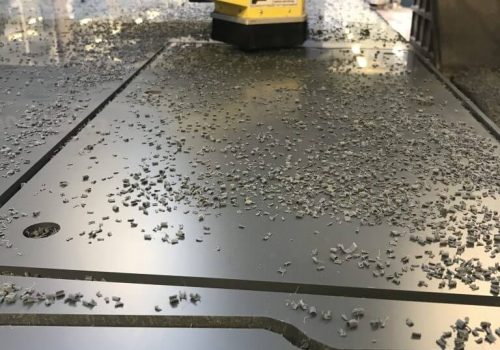
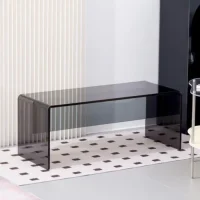
Tinted plexiglass comes in a variety of colors and light transmittance values, each providing different amounts of solar energy and visible light.
| Properties | Test Conditions | Test Method | Unit | Typical Values |
|---|---|---|---|---|
| Density | SO 1183-1 | g/cm3 | 1.2 | |
| Water absorption saturation | Water at 23°C | ISO 62 | <41mg | |
| Tensile strength | 1mm/min | ISO 527-1, -2 | Mpa | 76 |
| Tensile modulus | ISO 527-1, -2 | Mpa | 3110 | |
| Flexural strength | 2mm/min | ISO 178:2019 | Mpa | 115 |
| IZOD impact strength (Notched) | 23°C, 50% relative humidity, 3.2mm | ASTM D256-10 Method A | J/m | 1.6 |
| VICAT Softening Temperature | 50N, 50K/h | ISO 306: 2013 | °C | 103 |
| Thermal conductivity | 23°C | ISO 8302 | W/mK | 0.19 |
| compressive yield strength | 1mm/min | ISO 604 | MPa | 110 |
| Indentation hardness | ISO 2039-1 | Mpa | 175 | |
| Rockwell hardness | HRM | M100 |
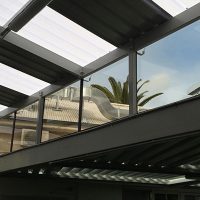
Tinted color windows feature acrylic panels that reduce glare, control solar heat gain, and enhance privacy. They improve energy efficiency, provide a stylish appearance, and increase comfort by reducing brightness and interior temperature.
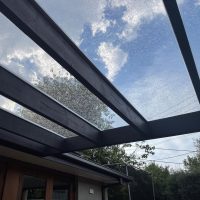
Excelite patio covers, aluminum pergola is made from t Tinted plexiglas. We offer carport kits packaged for simple DIY installation. Customization is also available with panel styles, colors and accents.

Smoked color plexiglass sheet used as a boat window is a lightweight, impact-resistant, and durable protective panel that provides tinted shading to reduce glare and enhance privacy.
Manufactured by mixing and heating to form a liquid acrylic mixture, and poured into the casting mold, where evenly to form a uniform sheet.
It has better thermal stability, higher resistance to cracking, good thermoforming range, is UV-resistant, and has greater scratch tolerances.
It is completely transparent and has excellent optical clarity.
Cast acrylic can easily be shaped, machined, and laser-cut.
Extruded acrylic sheet is a type of acrylic material that is manufactured through an extrusion process. In this process, acrylic polymer are heated and melted being pushed through a die to form a continuous sheet. It yields a material with a more even thickness throughout the sheet.
It is lightweight, stronger than glass, UV resistant, has good clarity and is transparent, and is the more cost-effective of the acrylic options.
Extruded acrylic also has good malleable properties making it easier to mold and bend. It can also be machined and laser cut.
Plexiglass sheets can be easily cut to size, but it is essential to note that they are more easy to crush when compared to polycarbonate. There are various processing methods such as drilling, sawing, milling, polishing, and fabrication can be employed for machining acrylic sheets.
At Excelite, we provide cut-to-size and comprehensive custom services for our customers. We guarantee precision cutting sizes and tight tolerances for our products. Whether you require a small trial quantity or shipping in your final sizes, we can accommodate your needs.
In most of applications, people need to get a matte surface, or smooth edges in high traffic areas, sanding acrylic before final polishing is necessary.
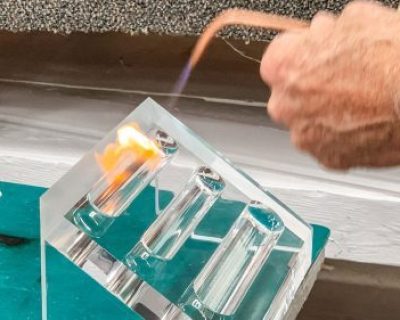
Polishing acrylic sheets enhances the appearance of the edges, providing a shiny finish. Whether through flame polishing, buff polishing, or machine polishing, there are various methods to achieve a glossy shine effect on the edges.
Hot Bending
Acrylic sheets can be formed into almost any shape. It provides highly freedom to get ideas.
Two primary heating techniques are surface heating and linear heating, each providing specific benefits depending on the desired outcome.
Heating can be accomplished using different methods, such as air-flow ovens, infrared radiation, or hot plates, with infrared heating being the most popular.
It is important to remove any protective film from the sheet prior to heating to prevent damage post-cooling.
After forming the acrylic sheets, it should be allowed to cool slowly in a stable environment to maintain its shape and structural integrity.
Cold Bending
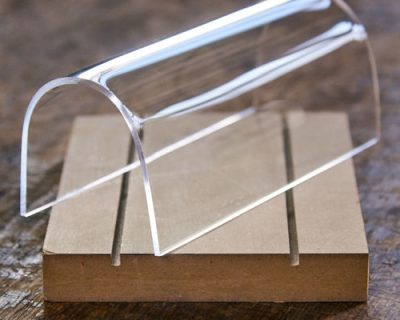
Unlike polycarbonate, Acrylic/Plexiglass sheets are relatively brittle, so it is important to avoid applying excessive pressure when cold bending them to prevent cracking.
After cold bending acrylic sheets, clamp the material in a mold or frame to avoid it from springing back to the original shape of the plate.
Recommended Minimum Radii of Curvature for Cold-formed Acrylic Sheets
| Thickness(mm) | Cast Acrylic Sheets | Extruded Acrylic Sheets |
|---|---|---|
| 1.5 | NA | 18 |
| 2.5 | NA | 29 |
| 3 | 21 | 35 |
| 4.5 | 32 | 53 |
| 6 | 42.5 | 71 |
| 8.5 | 60 | 100 |
| 12 | 86 | 143 |
Radii of curvature less than those specified may exceed the design stress limits for the material, resulting in crazing.
NA = Not Applicable.
DIY projects with precision-cut acrylic products and accessories!
Easily buy custom-cut acrylic sheets and all the essentials you need.
Shop now for quality materials and start creating!
1. The best way to cut acrylic sheets is to use a sharp cutting tool specifically designed for acrylic, such as a plastic sheet cutter, acrylic scoring tool, or a fine-toothed saw blade.
2. For straight cuts, a table saw or circular saw with a carbide-tipped blade can be used. Ensure that the blade is suitable for cutting acrylic and has a high tooth count to prevent chipping.
3. Another method for straight cuts is scoring the acrylic sheet with a plastic cutter or utility knife along a straight edge and then snapping the sheet along the scored line.
4. For curved or intricate cuts, a jigsaw, coping saw, or band saw with a fine-toothed blade can be used. Proceed with slow and steady cutting to prevent cracking or melting of the acrylic.
5. When cutting acrylic, it is important to properly secure the sheet to prevent vibrations that can lead to chipping or cracking. Using clamps or a non-slip mat can help keep the sheet in place during cutting.
6. To minimize chipping or melting, cut the acrylic sheet at a slower speed and avoid applying excessive pressure or force. Let the tool do the work to achieve clean and accurate cuts.
7. After cutting, remove any rough edges or burrs with sandpaper or a deburring tool for a smooth finish.
8. Always wear appropriate safety gear, such as goggles and a dust mask, when cutting acrylic sheets to protect yourself from flying debris and dust.
Polycarbonate is generally considered to be stronger than plexiglass (acrylic) of impact resistance. Polycarbonate is known for its high impact strength and is often used in applications where durability and resistance to breakage are essential. It is commonly used in bulletproof windows, safety glasses, and protective shields due to its ability to withstand high impact forces without shattering.
On the other hand, plexiglass (acrylic) is more brittle and prone to cracking or breaking upon impact compared to polycarbonate. While plexiglass offers good optical clarity and chemical resistance, it is not as impact-resistant as polycarbonate.
Acrylic sheets can crack under certain circumstances, but they are less prone to cracking compared to glass due to their higher impact resistance.
Looking to transform your vision into a tangible product?
At Excelite Plastics, every project is unique.
Block 1 RuiSu Building, 2 Kecheng Rd, Suzhou, China 215122
Australia Branch: 6 Stephen Road, Dandenong South 3175