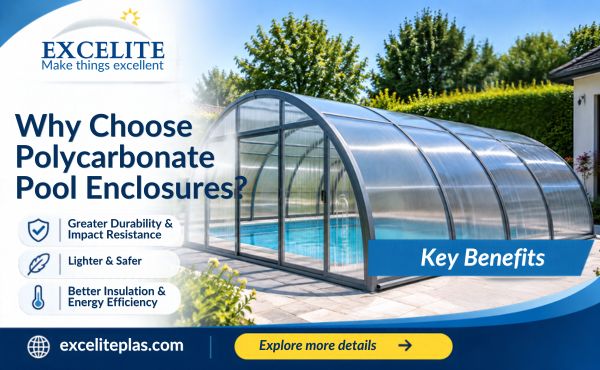
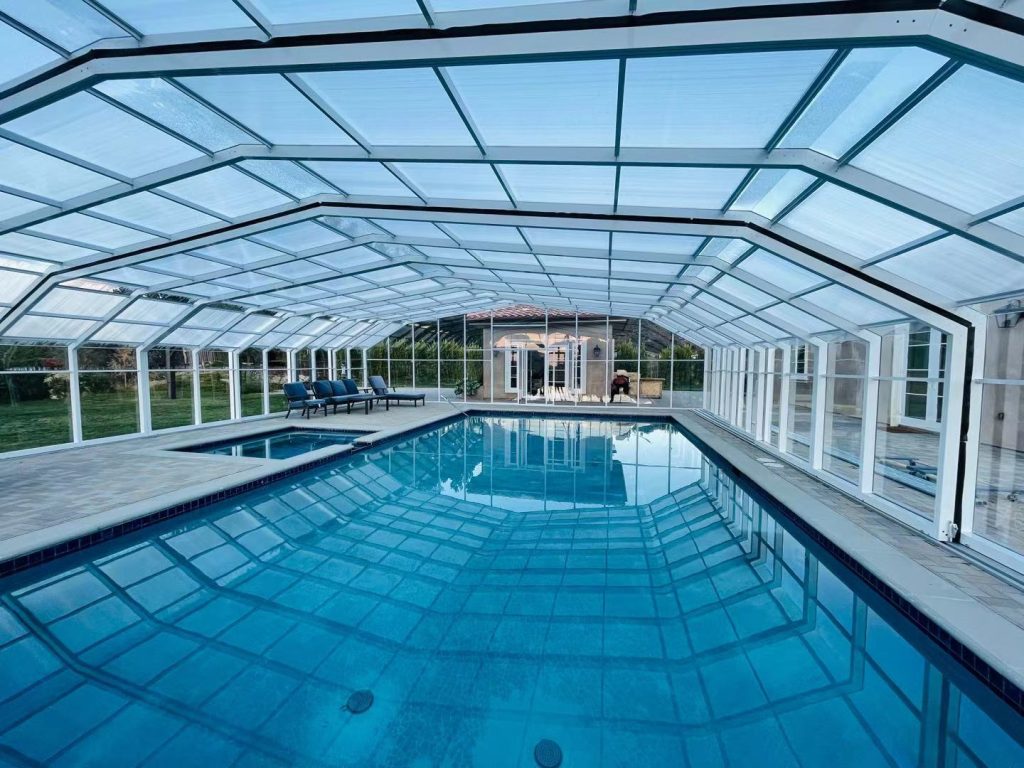
Polycarbonate pool enclosures provide an effective way to protect swimming pools from outdoor weather, debris, and excessive environmental exposure. Their main advantages include high impact resistance, lightweight construction, UV protection, improved thermal performance, and flexible design options.
Unlike traditional mesh pool screens, polycarbonate panels create a solid protective barrier while allowing natural light to enter the enclosed area. Depending on the panel structure, they can also help reduce heat loss and create a more comfortable swimming environment during cooler seasons.
These characteristics make polycarbonate suitable for residential swimming pools, commercial pool facilities, retractable enclosures, and architectural pool structures. Understanding how these benefits work helps property owners, contractors, and enclosure manufacturers select appropriate materials for their projects.
How Polycarbonate Pool Enclosures Improve Pool Protection
One of the main benefits of polycarbonate pool enclosures is their ability to protect swimming areas from external environmental conditions.
Polycarbonate is an engineering thermoplastic known for its high impact resistance. Unlike ordinary glass, which can fracture under sudden impact, polycarbonate can absorb substantial impact energy through controlled deformation. This makes it suitable for outdoor structures exposed to hail, windborne debris, falling branches, and accidental contact.
Its flexibility also makes it useful for curved enclosure roofs and other structures where rigid glazing materials may require more complicated fabrication.
A polycarbonate enclosure provides a physical barrier against rain, leaves, dust, insects, and wind. This helps protect pool water from external contamination and reduces direct exposure to changing weather conditions.
However, impact resistance should not be confused with structural load capacity. The complete enclosure must be designed to withstand local wind pressure, snow loads, and other environmental forces. Panel thickness, support spacing, frame connections, and anchoring all influence the structural performance of the installation.
For outdoor applications, UV-protected polycarbonate grades should also be specified to maintain the material’s performance during prolonged sunlight exposure.
Better Temperature Retention and a Longer Swimming Season
Polycarbonate pool enclosures can improve the thermal conditions around a swimming pool by reducing direct exposure to cold air and wind.
Outdoor swimming pools continuously exchange heat with their surroundings. Wind increases convective heat transfer and can accelerate evaporation from the water surface. Since evaporation is a major source of swimming pool heat loss, reducing direct wind exposure can help maintain more stable conditions.
A solid enclosure creates a sheltered environment where solar radiation can warm the enclosed air and surrounding surfaces. This can make swimming more comfortable during spring and autumn, particularly in regions with noticeable seasonal temperature changes.
Multiwall polycarbonate panels offer additional thermal advantages because their internal air chambers reduce heat transfer through the glazing.
The actual insulation performance depends on panel thickness, internal wall structure, and the overall enclosure design. A thicker multiwall sheet with a suitable cellular configuration may provide better insulation than a single-layer solid panel.
However, an enclosure is not a replacement for an insulated pool cover or a properly designed heating system. Evaporation can continue inside the enclosed space, and heat can still escape through ventilation openings, glazing joints, and other structural components.
The practical advantage is improved temperature management and the potential to extend the swimming season, rather than guaranteed year-round swimming without additional heating.
UV Protection and Natural Light Transmission
Polycarbonate pool enclosures allow natural daylight into the swimming area while offering options for reducing ultraviolet exposure.
UV Protection for Outdoor Applications
Many exterior-grade polycarbonate sheets incorporate a UV-protective layer that absorbs or filters harmful ultraviolet radiation. This layer also protects the polymer itself from prolonged sunlight exposure, helping reduce premature yellowing, surface deterioration, and loss of mechanical properties.
The UV protection may be applied to one or both sides of the sheet, depending on the product specification. During installation, the protected surface must face the direction specified by the manufacturer.
UV protection is particularly important for pool enclosures because the panels remain exposed to sunlight throughout the year. Selecting an appropriate exterior-grade product helps maintain both appearance and performance over time.
Maintaining Natural Light and Visibility
Polycarbonate is available in different transparency and light-diffusion options.
Clear solid polycarbonate sheets provide relatively unobstructed visibility and are suitable for enclosure walls and roof sections where outdoor views are important.
Multiwall polycarbonate has internal chambers that scatter light, creating a more diffused appearance. This can be useful for roof applications where softer daylight is preferred.
Tinted, bronze, and opal panels provide additional options for managing brightness and glare. They may also help reduce excessive solar heat gain, depending on their optical properties.
It is important to distinguish UV protection from solar heat control. A panel can block much of the ultraviolet radiation while still allowing enough visible and infrared solar energy to warm the enclosed space.
For projects in hot climates, solar-control panels, shading, or additional ventilation may be necessary.
Less Debris and Easier Pool Maintenance
Outdoor swimming pools are regularly exposed to leaves, insects, dust, pollen, and other environmental contaminants.
A polycarbonate pool enclosure creates a physical barrier that reduces the amount of external debris entering the swimming area. When doors and movable sections remain closed, fewer leaves and airborne contaminants can reach the water.
This can reduce routine cleaning work, including surface skimming, debris removal, and cleaning of pool collection baskets. It may also reduce the amount of organic material entering the filtration system.
The benefit is particularly noticeable for pools located near trees, gardens, or areas exposed to seasonal pollen.
However, an enclosure does not eliminate the need for proper water treatment. Filtration, circulation, disinfection, and chemical testing remain essential for maintaining safe swimming conditions.
The panels themselves also require periodic cleaning. Dust, rain marks, and mineral deposits can accumulate on the surface. Polycarbonate should be cleaned using compatible products and soft materials rather than abrasive pads or aggressive solvents.
The main advantage is reduced environmental contamination and less frequent debris removal, not a maintenance-free swimming pool.
Lightweight Construction and Flexible Enclosure Designs
Polycarbonate has a lower density than conventional glass, making it attractive for large glazing areas and movable enclosure structures.
Its relatively low weight can reduce the dead load transferred to supporting frames, roof members, tracks, and mechanical components. This is particularly useful for retractable and telescopic pool enclosures, where the weight of individual sections affects their movement and operation.
Solid and Multiwall Panel Options
Solid polycarbonate sheets provide a relatively clear appearance and are suitable for areas where visibility is important. They can also be cold-bent within the manufacturer’s permitted bending radius.
Multiwall sheets contain internal air chambers that improve insulation while reducing material weight. They are commonly used for roof sections where thermal performance and diffused natural light are priorities.
These different structures allow manufacturers to select glazing according to the function of each enclosure section.
Flexible Enclosure Configurations
Polycarbonate panels can be used in several enclosure designs, including:
- Fixed swimming pool roofs and sidewalls.
- Arched and curved enclosure structures.
- Retractable and telescopic pool enclosures.
- Walk-in swimming pool shelters.
- Combined solid and multiwall glazing systems.
For example, a manufacturer may use clear solid polycarbonate on the sidewalls to maintain outdoor visibility while installing multiwall sheets on the roof to improve insulation.
Polycarbonate does expand and contract with temperature changes. The glazing system must therefore provide sufficient movement allowance to prevent stress, distortion, or damage around panel connections.

What Are the Limitations of Polycarbonate Pool Enclosures?
Although polycarbonate offers several advantages, its limitations should be considered before selecting it for a swimming pool project.
Surface Scratching
Uncoated polycarbonate is generally more susceptible to abrasion than glass. Abrasive cleaning materials, hard brushes, and unsuitable chemicals can damage its surface and reduce optical clarity.
Specialized coatings may improve scratch resistance, but they should not be assumed to provide the same surface hardness as glass.
Condensation and Moisture Management
Swimming pools release moisture into the surrounding air, particularly when water temperatures are high.
Without sufficient ventilation and humidity control, condensation can form on enclosure surfaces and within poorly detailed assemblies. Multiwall panels also require suitable edge closures and drainage arrangements to prevent moisture and dirt from entering their internal channels.
UV Exposure and Thermal Expansion
Lower-quality panels without adequate UV protection may discolor or deteriorate during prolonged outdoor exposure.
Polycarbonate also expands and contracts more than glass when temperatures change. Incorrectly installed panels may develop distortion or stress around fasteners and connections.
These limitations can be managed through suitable material specifications, proper installation, and manufacturer-approved maintenance procedures.
How to Select Polycarbonate Panels for Pool Enclosures
Selecting the right panel structure is essential to achieving the expected performance of a swimming pool enclosure.
Solid polycarbonate is generally suitable for areas requiring clear visibility and a relatively glass-like appearance. It can be used for sidewalls, end walls, and selected roof sections.
Multiwall polycarbonate is often more appropriate for roof applications where thermal insulation and light diffusion are important.
Before selecting panels, manufacturers and contractors should evaluate:
- Panel thickness and internal structure.
- Visible light transmission and solar-control characteristics.
- UV-protection specifications.
- Thermal performance and U-value.
- Wind and snow load requirements.
- Permitted bending radius and support spacing.
- Chemical compatibility and cleaning requirements.
- Warranty conditions and installation instructions.
For multiwall panels, channel orientation, end closures, and drainage details deserve particular attention.
The best material is not necessarily the thickest or most expensive sheet. It is the panel that meets the structural, thermal, optical, and environmental requirements of the specific enclosure.
Conclusion: Are Polycarbonate Pool Enclosures Worth It?
Polycarbonate pool enclosures are worth considering when a project requires impact-resistant glazing, lightweight construction, weather protection, and flexible architectural designs. They can reduce debris entering the pool, provide UV protection, and improve thermal conditions when suitable multiwall panels are used.
Solid polycarbonate is useful where clear visibility is important, while multiwall panels offer additional insulation for roof applications.
Their long-term performance depends on the selected panel grade, UV protection, installation quality, and ventilation design. For pool enclosure manufacturers and contractors, matching the panel structure to the intended application is essential to balancing durability, appearance, and overall project cost.