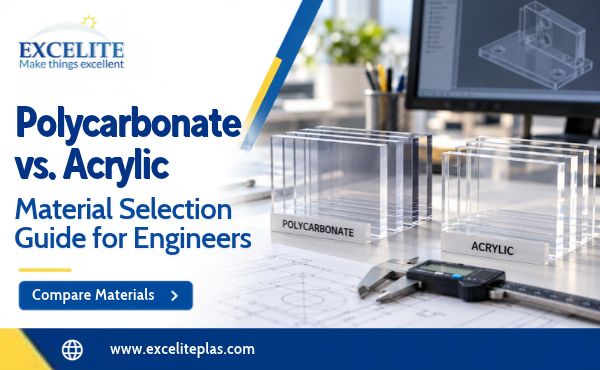
Choose polycarbonate when impact toughness and greater heat tolerance are central requirements. Consider acrylic when optical appearance, surface hardness, weatherability, and polished edges carry more weight. Both materials are available in specialised grades, so the final decision must reflect the actual application.
A useful polycarbonate and acrylic material selection process starts with service conditions rather than a list of generic properties. Panel size, chemicals, cleaning, fabrication, fire requirements, and replacement costs can all change which material offers the better result.
Start with the Application Requirements
Before comparing PC and PMMA, define what the component must do.
Will it protect people, display a product, cover a light source, or provide a viewing window? A clear display case and a machine guard may look similar while having very different requirements.
Record the expected loads and impacts, operating temperatures, sunlight exposure, cleaning methods, and installation conditions.
Also identify the acceptable failure mode. A decorative panel may be replaced after a crack appears. A protective guard must maintain the safety function defined by the equipment assessment.
Finally, separate mandatory requirements from preferences. A required approval or chemical exposure limit can eliminate an option before appearance and price are considered.
Polycarbonate vs. Acrylic Comparison Table
The following comparison describes general tendencies for conventional sheet materials. Specialised formulations and coatings can change the balance.
| Selection factor | Polycarbonate | Acrylic |
|---|---|---|
| Impact toughness | Usually the stronger starting point | More vulnerable to cracking under impact |
| Stiffness | Toughness does not mean greater rigidity | Often stiffer than standard PC |
| Optical appearance | Good transparency in suitable grades | Excellent clarity and polished-edge appearance |
| Surface scratching | Standard uncoated surfaces scratch readily | Generally harder than standard uncoated PC |
| Outdoor exposure | Usually requires an appropriate UV-protected grade | Strong weatherability in suitable grades |
| Heat tolerance | Generally higher | Generally lower |
| Fabrication | Useful for tough formed or machined parts | Useful for detailed fabrication and edge finishing |
| Fire performance | Depends on the exact grade | Depends on the exact grade |
| Chemical compatibility | Must be checked against actual exposure | Must be checked against actual exposure |
Use this table to establish a shortlist, then compare product data under equivalent test conditions.
Mechanical Performance
Impact Resistance and Failure Behaviour
Polycarbonate is widely selected for applications where accidental impact is a major concern. It can absorb deformation that would cause a more brittle transparent material to crack.
Acrylic is often suitable where impact exposure is limited or controlled. Impact-modified grades can provide another option, although their properties must be checked separately.
Avoid relying on statements that one material is a fixed number of times stronger than another. Impact results depend on the test method, specimen shape, thickness, notches, temperature, and mounting.
For a protective component, the relevant question is whether the finished part performs adequately under the foreseeable event.
Stiffness, Deflection, and Creep
Impact resistance and stiffness describe different behaviour. A material can be difficult to break while still bending noticeably.
Acrylic is generally stiffer than conventional polycarbonate, but thickness and support strongly influence the finished panel’s deflection.
Long-term loading also deserves attention. Plastics can gradually deform under a sustained load, a behaviour called creep.
For shelves, covers, and panels that remain loaded, use suitable long-term design information. A short-term strength value does not establish acceptable performance over several years.
Scratching and Surface Wear
Standard acrylic generally resists light surface scratching better than standard uncoated polycarbonate.
However, neither should be treated as equivalent to glass for abrasion resistance.
Hard-coated polycarbonate can be useful where toughness and surface durability are both important. Check whether the coating permits forming, bending, machining, or repair.
Acrylic can often be refinished or polished, but this requires suitable techniques and may not be appropriate for every component.

Optical Performance and Outdoor Exposure
Transparency and Appearance
Both materials can provide good visibility in clear grades. The perceived result depends on haze, tint, surface finish, thickness, and viewing angle.
Acrylic is often chosen for displays and presentation components because of its optical appearance and polished edges.
For inspection windows, compare samples using the actual viewing conditions. A component viewed at an angle through a thick section may reveal optical effects that are not obvious in a small sample.
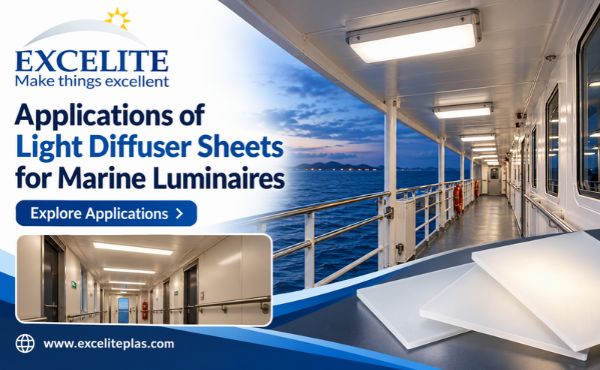
Light-Diffusing Applications
Clear-sheet transmission data should not be used to select a light diffuser.
Lighting grades contain structures or additives designed to scatter light. Their performance depends on thickness, LED spacing, optical distance, and the intended distribution.
The brightest sheet is not necessarily the one that hides LED points most effectively. Evaluate uniformity and output together.
Sunlight and Weathering
Acrylic is recognised for strong weatherability in appropriate products. Polycarbonate used outdoors commonly needs suitable UV protection.
Röhm’s material guidance identifies inherent weathering resistance as a reason for acrylic’s long-term optical use. Product-specific limitations still apply.
Confirm which surfaces are protected and whether cutting or installation changes exposure. Warranty conditions should also be reviewed rather than treated as a general service-life guarantee.
Temperature and Chemical Compatibility
Working Temperature Versus Test Temperature
Polycarbonate generally tolerates higher temperatures than acrylic, but a single temperature number rarely describes the whole design.
Heat-deflection temperature is measured under defined loading and test conditions. It is not automatically the maximum continuous operating temperature.
The component’s load, exposure duration, geometry, and acceptable distortion all matter.
Use the actual temperature reached by the part, including local heat sources and sunlight. A transparent cover can operate considerably warmer than the surrounding room.
Thermal Expansion
Both materials move as temperature changes. Installation should accommodate that movement without excessive stress.
Oversized holes, suitable edge clearance, compatible seals, and appropriate fastening arrangements may be necessary.
A replacement material may have similar expansion behaviour but different stiffness or notch sensitivity. Reusing an existing mounting design still requires review.
Chemicals, Cleaners, and Stress Cracking
Neither material is universally resistant to chemicals.
Compatibility depends on the substance, concentration, temperature, contact time, and stress within the component. Manufacturer guidance for polycarbonate specifically identifies these variables as important to application suitability.
Include cleaners, disinfectants, adhesives, sealants, oils, and incidental process chemicals in the review.
A flat unstressed sample may survive exposure that damages a tightly fastened or formed part. Where uncertainty remains, test representative finished components under realistic conditions.
Fabrication and Assembly
Cutting, Drilling, and Routing
Both materials can be machined, but tools and cutting conditions should match the material and thickness.
Poor machining can create rough edges, local heating, and stress concentrations. Drilling near an edge or overtightening a fastener can increase cracking risk.
Acrylic fabrication also depends on whether the sheet is cast or extruded. Thickness tolerances, machining response, and forming behaviour can differ.
For close-tolerance parts, specify the dimensions that matter rather than assuming nominal sheet thickness provides the required accuracy.
Forming and Bending
Polycarbonate offers useful cold-curving options in suitable grades and geometries. Minimum permitted radii must come from the product manufacturer.
Thermoforming conditions differ between materials. Polycarbonate may require drying before forming to prevent moisture-related defects.
Coatings can limit the permitted process. A sheet suitable for flat glazing may not remain suitable after forming.
Confirm the manufacturing route before finalising the material specification.
Joining and Edge Finishing
Acrylic can produce attractive polished edges and well-finished bonded assemblies when processed correctly.
Joining either material requires compatible products and controlled procedures. Adhesive strength alone is insufficient if the joint creates chemical attack or residual stress.
Design for access, repair, and replacement where practical. Mechanical fastening may simplify maintenance, but the connection must allow movement and avoid local overload.
Fire Performance and Special Requirements
Fire performance belongs to the specific grade and tested configuration.
A general material name does not establish a flame classification. Even within one product family, colour, thickness, and formulation may affect the available rating.
Special requirements such as ESD control, food contact, or defined optical performance also need relevant documentation.
Avoid transferring approval from a resin to a finished sheet or assembly without checking its scope.
For regulated applications, identify the required evidence early. Otherwise, a material that looks suitable in a prototype may become unacceptable when production documentation is reviewed.
Choosing by Application and Total Cost
| Application | Likely starting material | Condition that could change the choice |
|---|---|---|
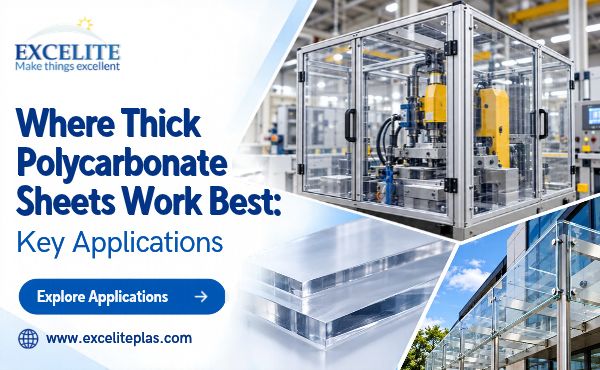
| Machine viewing guard | Polycarbonate | Chemical exposure or specialised safety requirements |
| Retail display cover | Acrylic | Frequent impact or rough handling |
| Outdoor sign face | Suitable acrylic or UV-protected PC | Impact, forming, and fire requirements |
| LED diffuser | Optical-grade acrylic or PC | Temperature and mechanical exposure |
| Protective equipment cover | Polycarbonate | Abrasion, chemical exposure, or optical needs |
| Polished display component | Acrylic | Load, fastening, or impact requirements |
Compare the delivered component cost rather than sheet price alone.
Machining, forming, coatings, rejected parts, cleaning, replacement frequency, and downtime all influence total cost.
A useful purchasing specification identifies the grade, thickness tolerance, finish, UV protection, required test evidence, and approved substitutions. This reduces the risk of receiving a visually similar material with different performance.
Frequently Asked Questions
Can both materials use the same drawing and tolerances?
Sometimes, but substitutions require review. Differences in stiffness, expansion, machining response, and cracking behaviour can affect dimensions and mounting details. A drawing developed for one material should not automatically be applied to the other.
Can protective film remain on the finished component?
Usually it should be removed according to the supplier’s instructions. Extended exposure to heat or sunlight may make removal difficult. Film intended for transport is not necessarily suitable as a permanent protective surface.
When is impact-modified acrylic worth considering?
It can be useful when standard acrylic’s appearance and fabrication characteristics are desirable but additional toughness is needed. Check the exact grade because optical, mechanical, and processing properties may differ from conventional acrylic.
What should a prototype test verify?
Test the conditions most likely to cause failure: impact, bending, heat, cleaning exposure, fastening stress, or weathering. Include assembly and repeated use where relevant. A prototype should represent the intended production material and process.
Conclusion
Polycarbonate and acrylic serve different priorities. Polycarbonate often suits impact-prone protective parts, while acrylic often suits optical presentation and weather-exposed applications with controlled impact.
Choose using the full service environment, fabrication route, and required evidence. Grade selection and component design are just as important as choosing between PC and PMMA.